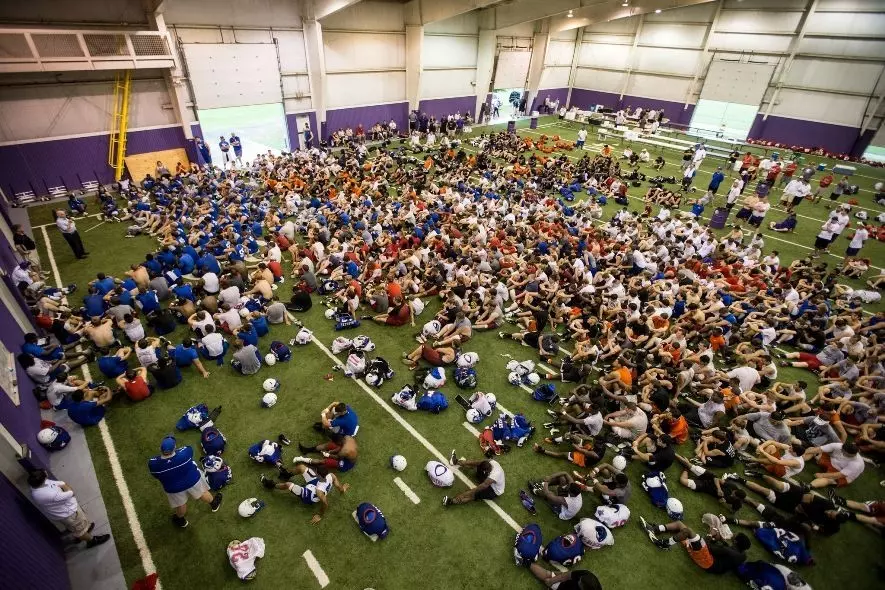
How to Stand Out When 500 Other Kids Are on the Field
Every summer, thousands of high school football prospects pack up their cleats, hop into cars with their parents, and head out to college mega-camps. The pitch is incredibly enticing: pay a registration fee, show up to a major university’s stadium, and perform in front of dozens of college coaching staffs all gathered in one single location. It sounds like the ultimate shortcut to recruiting exposure.
But when you actually pull up to the facility, reality quickly sets in. You look around and see a sea of 500, 600, or even 800 other athletes all wearing the same neon camp t-shirt. The lines for the 40-yard dash are a mile long, the coaches are shouting over megaphones, and individual attention seems almost impossible to come by.
It begs the question that every recruiting family eventually asks: Are mega-camps actually worth the time and money, or are they just a massive cattle call?
The truth is, mega-camps can be a highly effective weapon in your recruiting arsenal, but only if you change your entire approach. Most players show up hoping to “get discovered” by sheer luck. Elite prospects show up with a calculated business plan. If you want to stop blending into the crowd and actually force college scouts to write your name down on their boards, you have to master the strategy of navigating a mega-camp.
The Reality of the “Cattle Call”
To survive a mega-camp, you first have to understand why colleges host them. For the host school, it is a high-efficiency scouting tool and, frankly, a massive revenue generator for their football program. For the “guest” coaches—the Division II, Division III, and FCS coaches who fly in to work the camp—it’s a goldmine. They get to evaluate hundreds of prospects that their smaller travel budgets would never normally allow them to see.
Because of this dynamic, you must immediately shift your mindset. You are not there to impress all 50 coaches from 30 different schools. Trying to get everyone’s attention results in getting no one’s attention. Your goal is to identify a specific target package of schools that match your current projected talent level and outwork the room in front of them.
Pre-Camp Homework: The Hit List
The biggest mistake recruits make happens before they ever step foot on the turf. They register for a camp blindly without checking the roster of coaches scheduled to attend. Standing out starts days before the event even begins.
You need to research exactly which coaching staffs will be working the camp. Look for the assistant coaches, the personnel directors, and the quality control coaches who are assigned to your specific position group. Once you have a list of 5 to 10 target schools that fit your academic and athletic profile, you need to initiate contact.
Send a concise, professional direct message or email to those specific position coaches. Let them know your name, height, weight, graduation year, and attach your highlight link. Most importantly, give them your exact camp bib or jersey number if you have it, and tell them you are coming to their camp specifically to compete in front of them. When a coach arrives at a mega-camp with a pre-written list of 15 players they want to cross-check, you need your name on that paper before the first whistle blows.
Dominating the Complex: Phase by Phase
Once you arrive, the camp will typically be broken down into three distinct phases: testing, individual drills, and competitive periods. Each phase requires a different strategy to catch a scout’s eye.
1. The Testing Phase
Don’t let the long lines drain your energy or break your focus. If a college coach is supervising the 40-yard dash or the 5-10-5 shuttle line, that is your stage.
- The Strategy: Avoid hanging out at the back of a 50-man line talking to your friends. Get to the front, look the coach running the timer in the eyes, state your name clearly, and execute. If you post a blazing time, that coach is immediately going to circle your bib number on their roster.
2. Individual Drills (The Separation Period)
This is where the posers get filtered out from the real football players. When the camp breaks into position groups, the coaching staff will run you through footwork, change-of-direction, and technique drills.
- The Strategy: Do not hide in the back of the line. Push your way to the front of the line and take the very first reps. Coaches love alpha mentalities. Taking the first rep shows you are confident, unbothered by pressure, and eager to be coached. When the coach gives feedback or corrects a movement, listen intensely and apply that correction on your very next turn. Coaches aren’t just looking for polished products; they are looking for players who are highly coachable.
3. Competitive Periods (1-on-1s and 7-on-7)
This is the main event. This is where the numbers completely take over, and if you aren’t aggressive, you will get buried. In a 1-on-1 drill with 150 wide receivers and defensive backs, you might only get three total reps the entire afternoon if you just wait your turn.
- The Strategy: You have to hunt your reps. If you are a defensive back, find out who the top-rated wide receiver at the camp is, walk up to the front of the line, and challenge him directly. If you are an offensive lineman, call out the baddest defensive end in the dirt. College coaches congregate where the highest-rated players are competing. If you step into the ring against a known commodity and win that rep, you instantly steal his spotlight and force every camera on the sideline to turn your way.
The Post-Camp Protocol
The camp doesn’t end when you take your cleats off in the parking lot. The final piece of standing out is the follow-up. Within 24 hours of the camp concluding, send a follow-up message to the coaches you interacted with. Thank them for their time, mention a specific coaching tip they gave you during a drill, and ask what the next steps are in their evaluation process.
So, are mega-camps worth it? If you show up expecting a college scholarship to magically fall into your lap just because you paid an entry fee, the answer is absolutely no. It will be a waste of your money and a blow to your confidence.
But if you treat a mega-camp like an active business trip—doing your pre-camp homework, forcing your way to the front of every line, hunting down elite competition, and executing a professional follow-up strategy—then a mega-camp is one of the most powerful, cost-effective exposure tools in the entire country. Stop looking at the other 500 kids on the field. Focus on your target, dominate your reps, and force them to watch you.
About the Author